Remote Roof Measuring: What Works and What Doesn’t
If you're a roofing contractor, you've probably wasted time and money testing online roof measurement tools. One report says it’s accurate. The next one is way off. Then you're on Google trying to figure out if you can measure a roof online for free, or if you have to keep shelling out $40 a pop for every bid you send.
You're not alone. The truth is, remote roof measuring is a mixed bag. Some tools are fast and accurate. Others are outdated, expensive, or just plain wrong. The question isn't just "Can I measure a roof online?" It's, "Which method actually works, and which one wastes my money?"
Let’s break it all down.
The State of Remote Roof Measuring
These days, you’ve got options. Lots of them. Here’s a quick rundown of the most common ways contractors measure roofs without setting foot on a ladder:
1. Drones
Contractors or service providers use drones to fly over a property and take aerial images, then generate measurements based on the photos.
Pros:
- High accuracy
- Good for properties with lots of trees or obstructions
- You control the data collection
Cons:
- Expensive startup cost
- Requires FAA certification
- Weather and battery life can get in the way
- Not scalable for high-volume bidding
2. EagleView
The gold standard in aerial roof measurements, EagleView uses high-resolution satellite and aerial imagery to create detailed roof measurement reports.
Pros:
- Very accurate
- Includes pitch, square footage, lengths, and diagrams
- Recognized by insurers and large roofing companies
Cons:
- Expensive (typically $40–$75 per report)
- Can take several hours or even a day to deliver
- Overkill for simple or small jobs
3. Roofr
A newer player in the space, Roofr offers a mix of free and paid roof reports using satellite imagery and automated measurement tools.
Pros:
- Free starter reports
- Easy to use interface
- Offers upgrade options
Cons:
- Inconsistent accuracy
- Limited data for complex roofs
- Upsells can get pricey
4. BidEngine
BidEngine is designed specifically for contractors who want fast, affordable roof measurement reports that are accurate enough to close deals and win bids.
Pros:
- Reports start at just $9
- Fast turnaround
- Smart combination of automation and human quality control
- Easy to use on desktop or mobile
Cons:
- Not yet as widely recognized as EagleView
- Accuracy depends heavily on image quality (more on that later)
- Want to see where imagery is best? Here is a map of the high-resolution imagery that BidEngine has access to: https://www.nearmap.com/coverage
So What Works — and What Doesn’t?
Here’s where it gets real. Not every method works in every situation. Some work great for suburban neighborhoods with clear aerial images. Others struggle in more complex environments.
Let’s look at when these tools succeed — and when they fail.
What Works
1. Suburban or newer neighborhoods
If the home is in a newer subdivision with clear lot lines, few trees, and wide streets, most online roof measuring tools will perform well. The roof angles are usually simple, the satellite images are recent, and the reports come back fast and fairly accurate.
2. Clear skies and flat terrain
Image-based tools do well in areas with minimal distortion — no steep hills, no dense tree cover, and good lighting conditions when the imagery was captured.
3. Basic gable or hip roofs
Simple roof structures are easier to measure. Tools like BidEngine and Roofr can knock these out quickly and reliably.
What Doesn’t Work
1. Dense tree cover
Trees are one of the biggest problems for remote roof reports. If a branch is covering a corner of the roof, the software can’t see the lines — and the measurement will be off.
2. Older neighborhoods with irregular rooflines
Older homes often have additions, dormers, or strange roof angles that confuse automated tools. If the imagery is outdated or blurry, it gets worse. Most of the time these can be measured without issue, but sometimes they present difficulties.
3. Multi-family or complex roofs
Apartments, duplexes, or commercial buildings with irregular shapes often require human review or drone footage to get right. Many cheap online tools fall short here.
4. Blurry or outdated imagery
This is the true killer for accuracy. If you're getting a roof measurement report and the image it's based on is five years old or pixelated, it won’t matter how fancy the tool is. The result will be unreliable.
Can You Double-Check Accuracy?
Yes — and you should.
Even if you use remote tools, it's smart to spot-check the accuracy before finalizing your bid. Here's how:
1. Use Google Earth or a free satellite view tool
Pull up the same property and compare the satellite imagery. If you see trees or image issues, take the report with a grain of salt.
2. Cross-check dimensions manually
If you have a simple dimension (like the length of one eave), you can compare it to the reported number. Most software allows you to view and verify the dimensions on a map or sketch.
3. Check against the local property appraiser site
Some counties list square footage of the building footprint. This can help confirm if your reported numbers are in the right ballpark.
4. Use a hybrid approach
Many contractors use remote measurements to get the bid out fast — then verify key numbers during a site visit before starting work. This way, you stay competitive without risking major errors.
How BidEngine Balances Speed, Cost, and Accuracy
Here’s where BidEngine shines.
We built BidEngine specifically for contractors who are tired of choosing between overpriced reports and free ones that don’t work. Our goal: get you what you need to win more jobs, without eating into your profit margin.
Speed
BidEngine reports are delivered fast, typically within 10 to 30 minutes. No waiting 24 hours. No submitting a request and hoping someone gets to it. You get what you need when you need it.
Cost
At just $9 per report, BidEngine makes it affordable to send out multiple bids. For that price, you can quote three jobs for the cost of one EagleView report — and still be confident in your numbers.
Accuracy
We combine smart automation with human oversight. If the imagery is good, the system measures automatically. If there’s a problem — like tree cover or blurry images — we flag it or use backup techniques. No system is perfect, but we’re constantly refining ours to hit that sweet spot between speed and precision.
What You Should Look for in a Roof Measurement Report
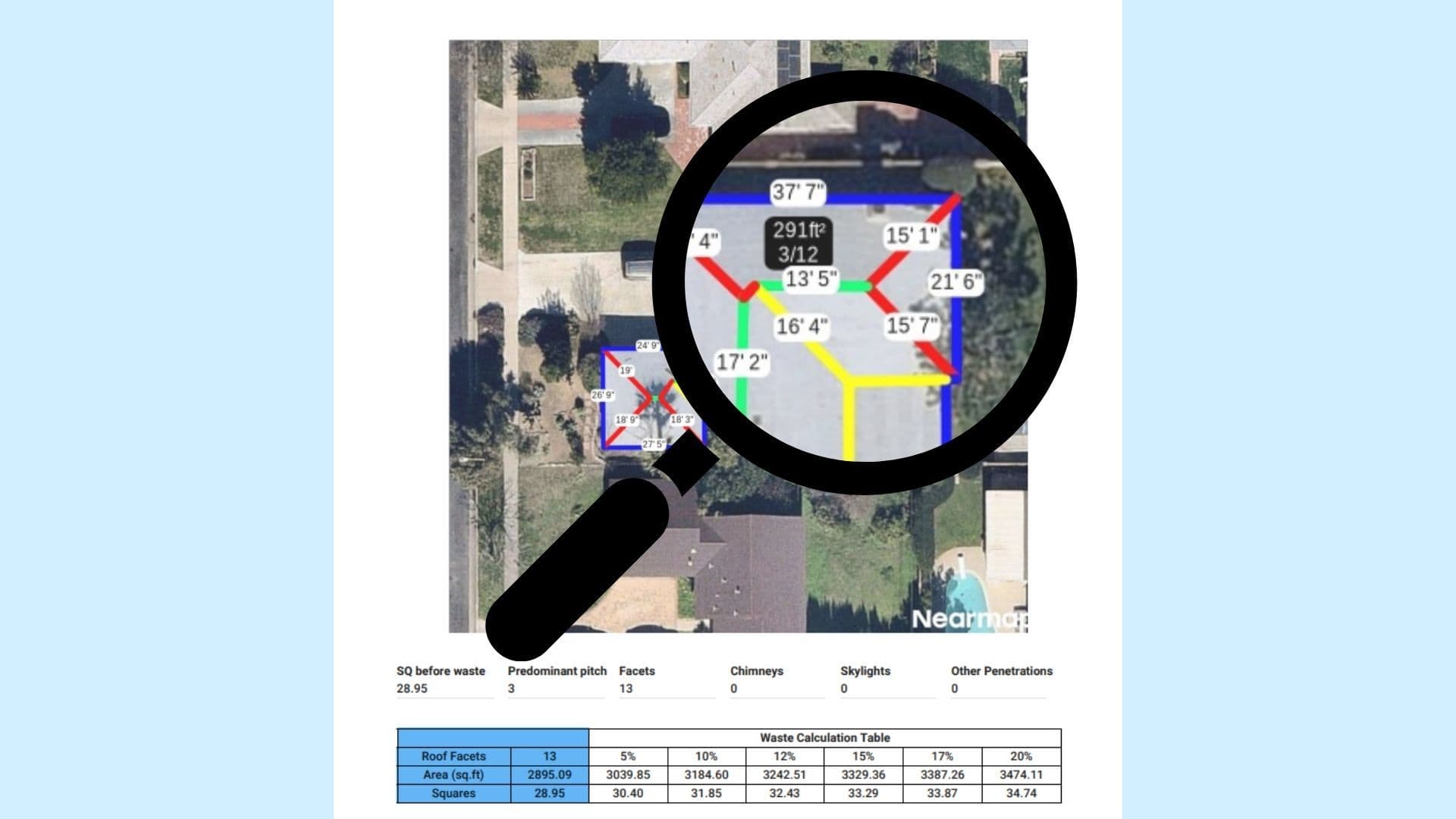
Whether you use BidEngine or not, here’s what every reliable roof report should include:
- Total square footage
- Roof pitch
- Eave, rake, valley, ridge, and flashing lengths
- Diagram or sketch
If you’re not getting that, or if the imagery is hard to read, it’s probably not worth paying for.
Final Thoughts
You can absolutely measure a roof online. Just not with every tool, and not for every property.
- For simple homes in newer neighborhoods, tools like BidEngine can get you accurate numbers fast.
- For complex properties, you may need a drone or premium report.
- And no matter what, always double-check when the stakes are high.
Don’t burn through $40 reports on every single job. Don’t waste time with free tools that give you garbage data. Find a tool that hits the right balance of cost, speed, and accuracy — and stick with it.
Try our $9 roof report and see how accurate it is on your next project.
Fast. Affordable. No guessing. Just solid numbers you can build on.
First 3 reports are FREE: https://reports.bidengine.app/